EXHIBITIONS
r e a : c l a i m e d [Dec 2025 – March 2026]
ACCA present a focused retrospective of Gamilaraay, Wailwan and Biripi digital media artist, r e a in 2025/26.
Playfully titled r e a : c l a i m e d, this thoughtful survey highlights the breadth and impact of r e a’s contemporary practice. Born in 1962 in Coonabarabran, New South Wales, r e a lives and works on Darug and Gundungurra Country, also known as the Blue Mountains.
This presentation includes an exciting new commission alongside a curated selection of works spanning more than three decades. Presented across three galleries, the exhibition is accompanied by the largest monograph of r e a’s work to date, cementing their position as one of Australia’s leading figures in contemporary art. With trans rights increasingly under threat internationally, this is a timely exhibition that addresses themes of memory, representation, intersectionality, and positionality.
r e a’s work has illuminated the ongoing impacts of colonisation on queer and Indigenous bodies. Their important practice has positioned them as a vital and inspiring presence in the Australian art landscape, making sustained and significant contributions to experimental new media practice. r e a was among the first Indigenous artists to exhibit at ACCA, participating in Blakness: Blak City Culture in 1994, alongside Destiny Deacon, Brook Andrew, Joanne Currie, and more. Working across photography, video, sound, performance, and multi-sensory installation, r e a explores their relationship to gender within the context of post-colonial Australia.
Archival storytelling is often central to r e a’s practice, which is deeply personal, generous, and provocative. Informed by new media theory, they layer text, image and colour to trace transgenerational histories and interrogate how attitudes toward race are embedded in both language and art. r e a : c l a i m e d continues ACCA’s commitment to presenting solo exhibitions of Australian artists at pivotal moments in their careers, affirming r e a’s place as a changemaker and senior figure in Australia’s contemporary art landscape.
Curated by: Myles Russell-Cook
r e a : c l a i m e d https://acca.melbourne/exhibition/r-e-a-c-l-a-i-m-e-d/
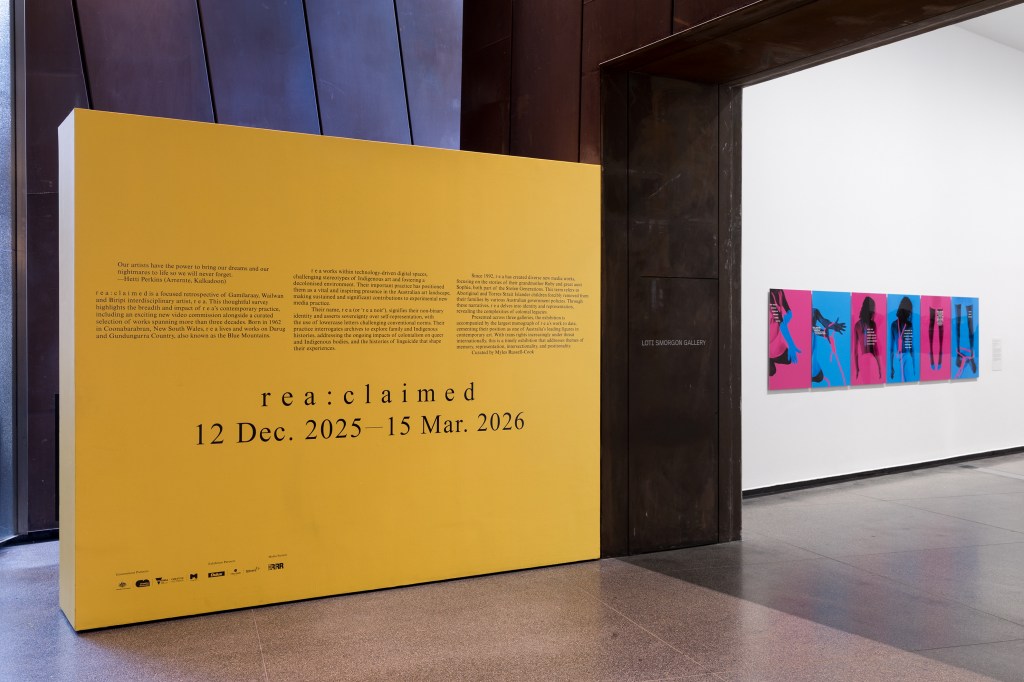
This new publication expands on the histories, biographies, thematics and mediums presented in the focused survey exhibition, r e a : c l a i m e d. The publication, r e a : c l a i m e d, is the largest monograph of r e a’s practice to-date.
The monograph spans a major curatorial essay by curator and editor of r e a : c l a i m e d, Myles Russell-Cook, and five new commissions by ACCA colleagues and external writers. Professor Lynette Russell AM, Judith Ryan AM, Dr Shelley McSpedden, Sophie Gerhard and Sophie Prince respectively respond to distinct works and ideas integral to understanding r e a’s work, purposefully extending and making permanent the experience of the exhibition itself.
r e a: c l a i m e d Catalogue PDF link below…
***********************
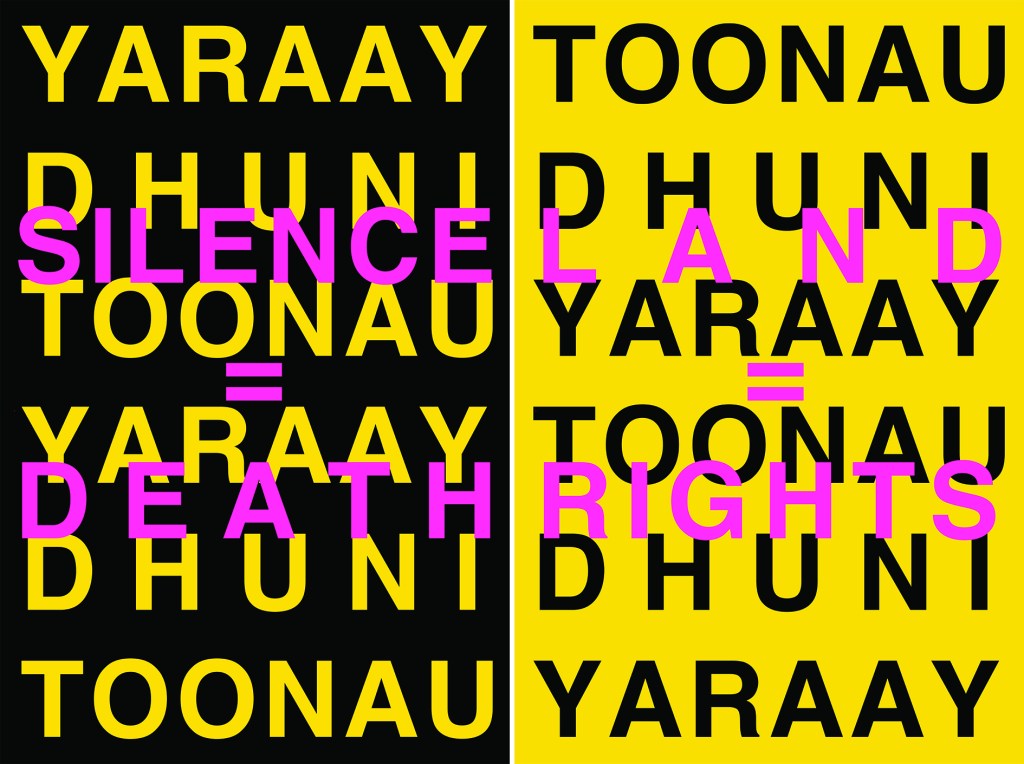
GARI (language) SILENCE = DEATH and LAND = RIGHTS [2024/25]
Original POSTER Artwork
***********************
GARI (language) BANNER SERIES [2024] part of the 24th Biennale of Sydney
Commissioned by Biennale of Sydney and Artspace, in collaboration with r e a to create a safe space for reflection. Courtesy the artist
In March 1987 a poster began appearing on the streets of New York City. All black, bar a single pink triangle, it read SILENCE = DEATH. Aware that their own increasingly urgent conversations regarding the ongoing HIV/AIDS epidemic were not reflected in broader discourse the Silence=Death Collective, led by Avram Finkelstein, had created one of the most iconic slogans of activist history.
In the wake of the 2023 Voice referendum, queer Gamilaraay/Wailwan/Biripi artist r e a has taken Finkelstein’s poster as inspiration to parallel the underlying politics that align both queer and blak bodies. On the exterior of The Gunnery building, r e a’s large banners depict the words for sun in the Gamilaraay, Wailwan and Biripi languages of the artist’s parents and grandparents. The work continues inside Artspace in the Ideas Platform, here interjected by SILENCE = DEATH and LAND = RIGHTS layering dual messages for audiences to decipher.
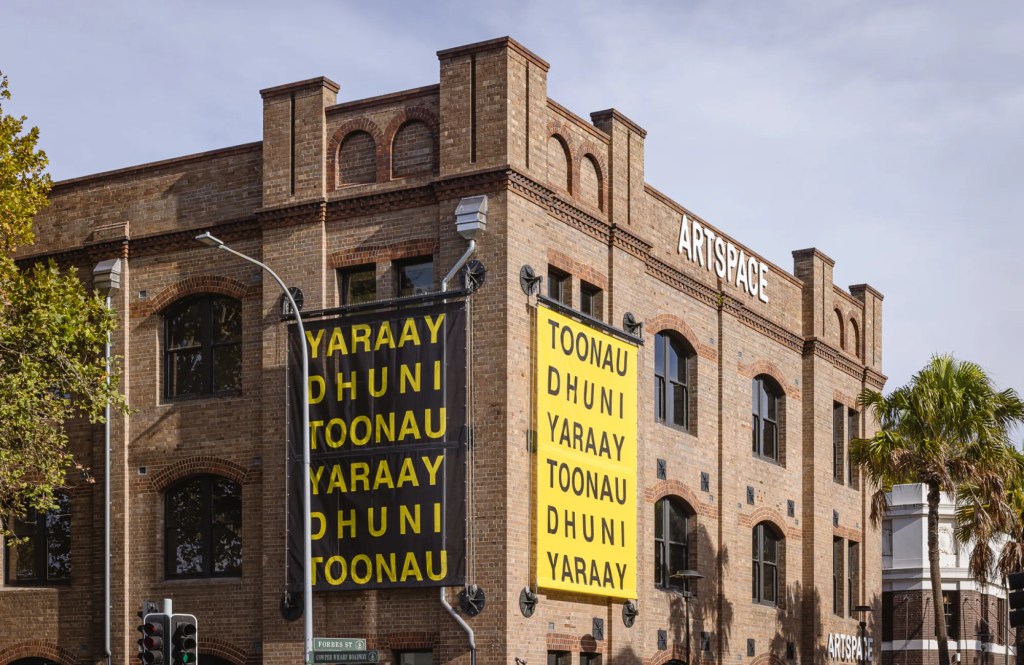
r e a has positioned blak, queer power as unavoidable and immutable as the rise and fall of the sun, the light at the end of tunnel.
The text on the Banners and walls translates as ‘sun’ in three languages:
YARAAY: Gamilaraay
DHUNI: Wailwan
TOONAU: Biripi
The text around the sun on the floor translates in Gamilaraay:
bunbul: meeting place
guurrama-li: resist, stand strong
burranba-li: cause a change
Textile Banners https://www.artspace.org.au/artists/r-e-a
***********************
tRAKa-tRAKn (burra bee dee) 2025/26
The first iteration was completed and exhibited in my community (Gamilaraay country) Coonabarabran, NSW in August 2024. In late 2025 the three-channel video work was reworked for first major public viewing in the r e a : c l a i m e d, retrospective at ACCA.
(The 1st 28secs of sound is in black)_3-Channel video & sound_14mins:04Secs.
r e a, a Gamilaraay/ Biripi / Wailwan artist (from Coonabarabran, NSW) over the past 6-years, I’ve been making this very important three-channel video work. The collaboration involved two young men from my family, my community elders & my creative team.
tRAKa-tRAKn is a poetic non-linear narrative of two young men who return to their maternal grand-mother’s land to find their cultural identity & connection to country. tRAKa-tRAKn endeavours to challenge the cycle of youth suicide by presenting cultural knowledge systems as a positive way of life for young, blak men by locating their bodies in the country of their ancestors.
I am the eldest child in my family, my role is not only as an artist & educator, I have a responsibility to deliver a deeper connection to cultural knowledge and country.
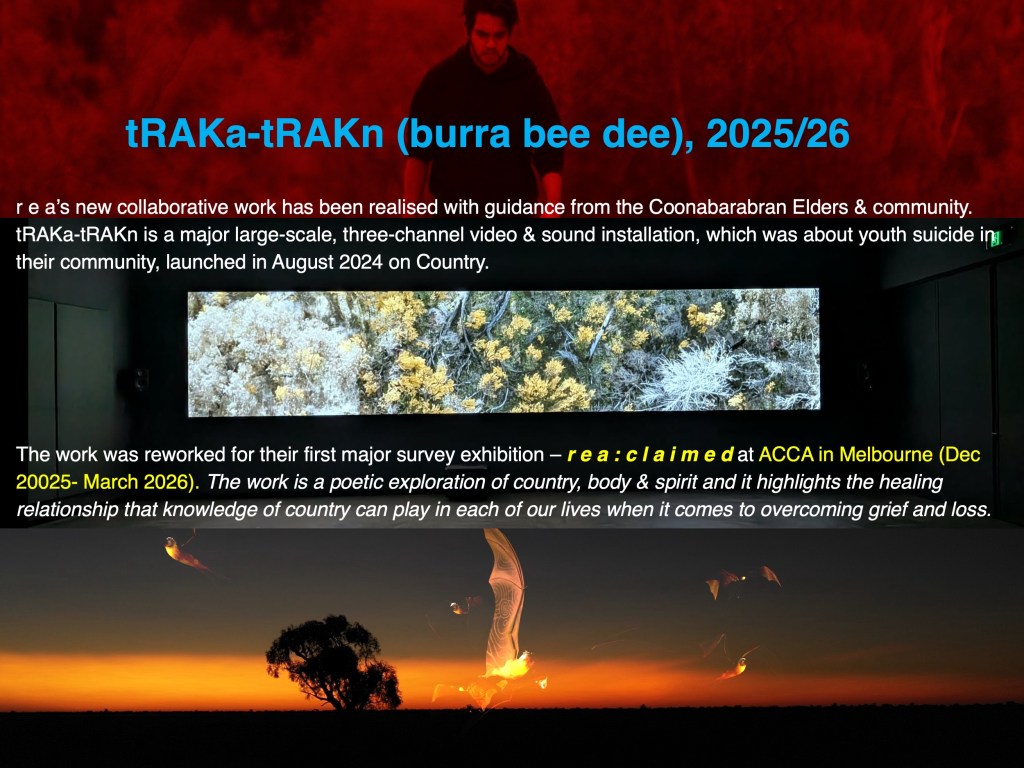
The Creative Team & collaborator’s – tRAKa tRAKn Project (2024/25) a three-channel video by r e a, a Gamilaraay/Wailwan/Bripi NSW interdisiplinary experimental digital artist
I am the Senior Artist, Creative Director, Co-Editor & Producer.
Thank you to: The ‘Flying Mice’ Coonabarabran Indigenous Elders Group who supported my creative project; and The Coonabarabran Local Aboriginal Lands Council – CEO, Brandon Nixon. My Nephew’s – who both inspired me to make this work with them, they are the two young men in the video work; (Great nephew) Joey Carriage (male voice), & (Nephew) Jet Thomas. My Family – (mum) Brenda Nicholas-Leslie & (sister) Lesley Morris; and my fellow country women: Suellyn Tighe (Gamilaraay language) for the female voices.
***********************
r e a: NATIVE [2024]
ISEA2024 EVERYWHEN Brisbane, Australia
For over three decades, r e a, a descendant of the Gamilaraay, Wailwan and Biripi peoples, has worked at the forefront of Australian Indigenous new media theory and practice in Australia and internationally. An artist, curator, activist, researcher and cultural educator, r e a explores themes of Indigenous identity, representation and the post-colonial experience across mediums, including photography, digital media, film, video and installation.
r e a: NATIVE comprises two interrelated installations delving into the historical and colonial archive. In the first room, we present a remastered iteration of r e a’s Native, 2013, a site-responsive sound and neon installation which was first developed as part of their Indigenous Artist Residency at the Blacktown Arts Centre in 2013.
In the second gallery, Native (yugal/song), 2024, incorporates video and motion sensors that enable viewers to use their bodies to experience sound and to perceive it in a visual form. The conceptual and physical touchstone of both installations is the Blacktown Native Institute, founded in Parramatta in 1815 and relocated to Blacktown in 1823, one of the first sites in Australia where Aboriginal children were removed from their parents and institutionalised. This resonated with r e a’s knowledge of their maternal grandmother’s experiences as a child of The Stolen Generation and how intergenerational trauma is passed on. However, the project extends beyond this focal point, offering broader reflections on how their body processes language when immersed in the archive, reclaiming and Indigenising r e a’s history, language and identity.
r e a: NATIVE Catalogue PDF link below…
***********************
Journal Articles
The Artificial as an Intelligent Indigenous/Indigenizing System, The Experimental Art and Artifice of r e a
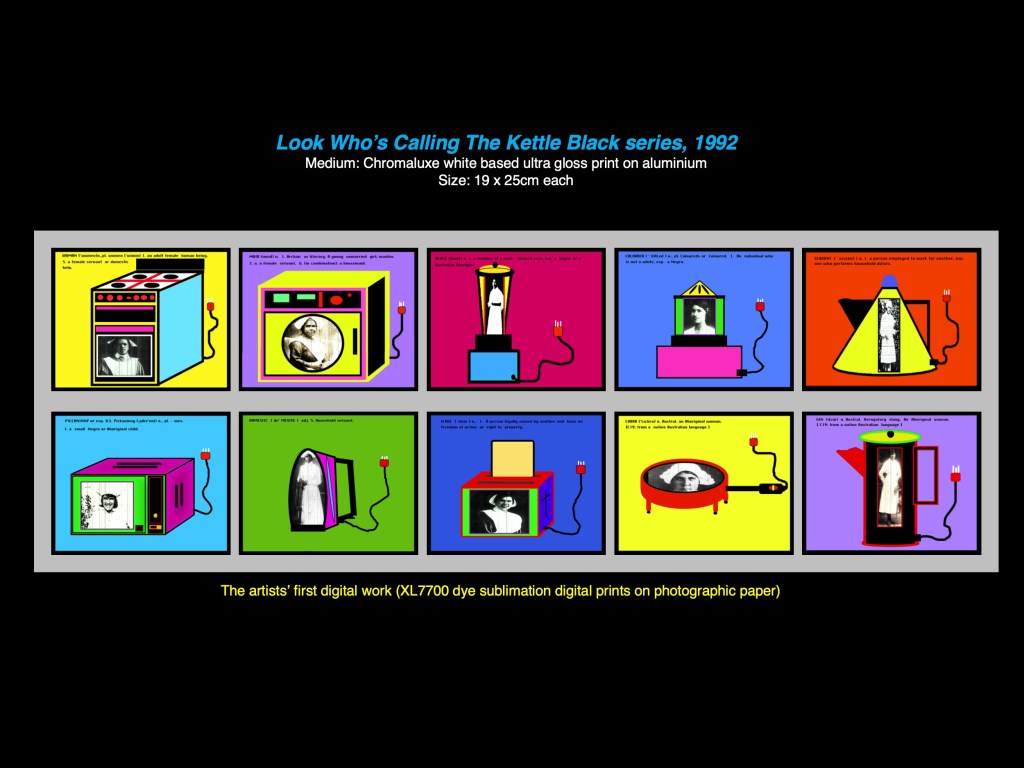
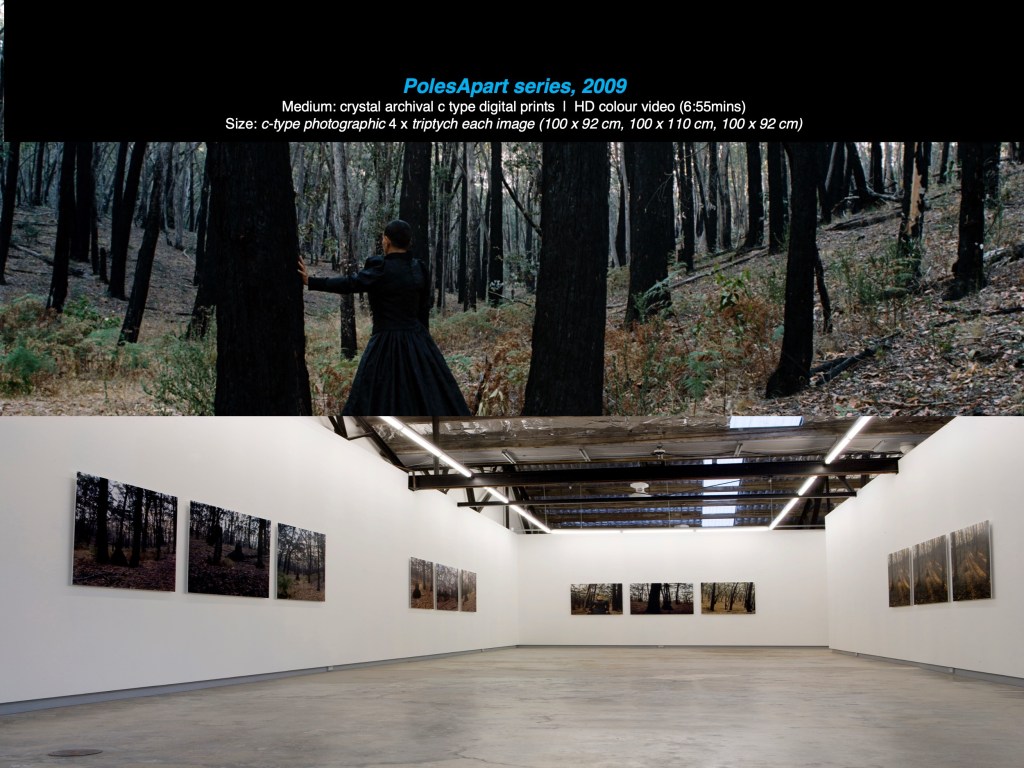
r e a, J.Biddle, L. Hibberd ‘The artificial as an intelligent Indigenous/indigenizing system’, Special Edition (Saunier, A. and Salter, C., eds.) Anthropology of the Artificial’ Visual Anthropology Review, 39:2 pp. 458-474
***********************